In the dense, sun-dappled world where monkey troops navigate shifting alliances and territorial rivalries, few moments are as raw and revealing as an invasion. That is precisely what unfolded in a recent wildlife video captured by the How Monkey Cry channel, where a young male monkey known as Slim found himself outmatched, overwhelmed, and ultimately forced to run.
The footage begins with the atmosphere already charged. The Cabzillar troupe — a name given to a rival group known for its bold and aggressive incursions — sweeps into territory where Slim had been moving with relative ease. What follows is a study in the brutal arithmetic of primate social dynamics. Numbers matter. Rank matters. And on this particular day, Slim had neither working in his favor.
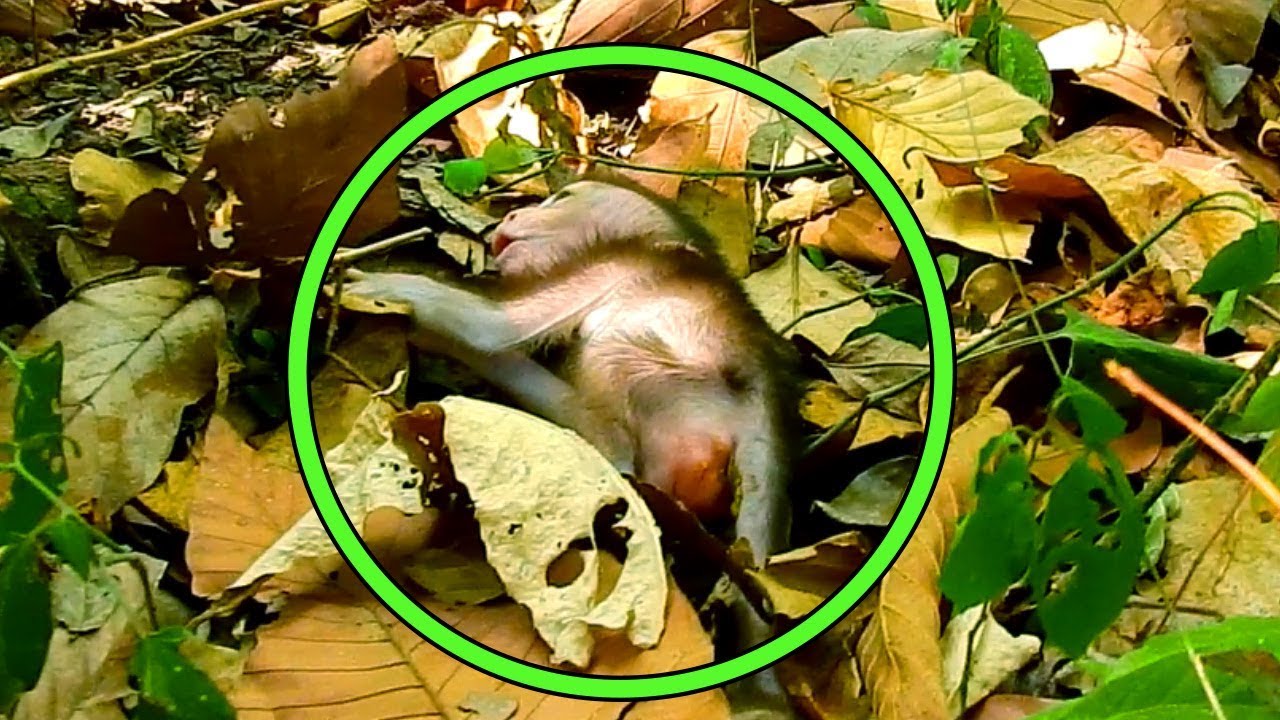
As the invaders pressed forward, Slim did what survival demanded: he ran. His departure, however, carried a cost that the camera captured with uncomfortable clarity. An infant, seemingly dependent on the proximity of adults for safety and comfort, was left behind in the chaos. The baby tumbled — a small, fragile form displaced by forces far beyond its understanding — and began to cry.
The infant’s cries echoed through the footage as the troupe settled into the space Slim had vacated. In primate communities, the sounds of a distressed infant carry enormous social weight. They signal vulnerability, they invite response, and they sometimes — though not always — prompt protective intervention from nearby adults. Here, in the immediate aftermath of the invasion, the baby was conspicuously alone.
Slim’s flight was not an act of indifference so much as an act of pure biological calculus. Adult males in wild primate groups frequently withdraw rather than engage when outnumbered by a rival coalition. Fighting back against superior numbers risks injury or worse, and an injured male is a male whose long-term survival prospects collapse quickly. In this light, the retreat reads less as abandonment and more as a hard-edged survival strategy shaped over millions of years of evolution.
Still, the optics are difficult. The image of a crying infant, alone and confused while adults scatter, is one that resonates far beyond the specifics of monkey behavior. It speaks to the precariousness of life at the margins of social structures, where the weakest members bear the sharpest costs of upheaval.
The How Monkey Cry channel has built a following by documenting precisely these kinds of unscripted, emotionally resonant moments in monkey communities. The footage does not editorialize. It simply watches, and in watching, reveals the complicated, often difficult truths of life in the wild.
For Slim, the outcome beyond the clip remains unknown. For the infant left crying in the aftermath of the Cabzillar troupe’s advance, the footage stands as a small but striking document of nature’s unyielding indifference to comfort.
Source: How Monkey Cry, YouTube.
Watch the original video →